Olive Oil Chemistry Explained : Olive Oil Chemical Analysis and Why It Matters
Olive oil is much more than just a kitchen staple. It is a product deeply rooted in science, tradition, and health. Yet, for many consumers, the different categories and various technical terms can feel confusing.
In this guide, we break down how olive oil is officially classified, what chemical analysis really means, and why these factors matter when choosing a truly high-quality extra virgin olive oil.
Laboratory Analysis
Chemical analysis is the foundation of olive oil classification and quality control. It consists of a series of laboratory tests that evaluate how the oil was produced, how fresh it is, and whether it has undergone degradation or improper handling. These measurements are not theoretical; they directly reflect the condition of the olives at harvest and the care taken during processing.
One of the most important parameters is free acidity, which indicates the breakdown of fatty acids in the oil. Low acidity suggests that the olives were fresh and processed quickly, while higher acidity often points to damage, fermentation, or delayed milling. Closely linked to freshness is the peroxide value, which measures the extent of oxidation. A low peroxide value indicates that the oil has been well preserved, whereas higher values signal exposure to oxygen, light, or heat.
Another critical component of analysis is ultraviolet absorbance, expressed through K values. These measurements detect deeper chemical changes, including oxidation byproducts and possible adulteration, offering a more advanced verification of purity. Alongside these parameters, the concentration of polyphenols plays a central role, not only in determining the oil’s stability but also in defining its nutritional and sensory profile.
Together, these elements form a complete chemical picture. They allow producers and regulators to classify olive oil accurately, while giving consumers a scientific basis for understanding quality.
How Chemistry Shapes Taste
The taste of olive oil is not simply a matter of preference; it is a direct expression of its chemical composition. The bitterness perceived on the tongue and the characteristic peppery sensation felt in the throat are closely linked to the presence of polyphenols, particularly compounds such as oleocanthal.
An olive oil that produces a slight cough or tingling sensation is often rich in these compounds, indicating both freshness and high antioxidant content. In contrast, oils that taste flat or overly smooth may have lower levels of these beneficial molecules, often as a result of later harvests or oxidation over time.
Fruitiness, another key sensory attribute, is associated with volatile aromatic compounds that develop during proper extraction. When these elements are balanced, the oil expresses complexity and freshness. In this way, taste becomes a reflection of chemistry, allowing consumers to perceive quality through sensory experience.
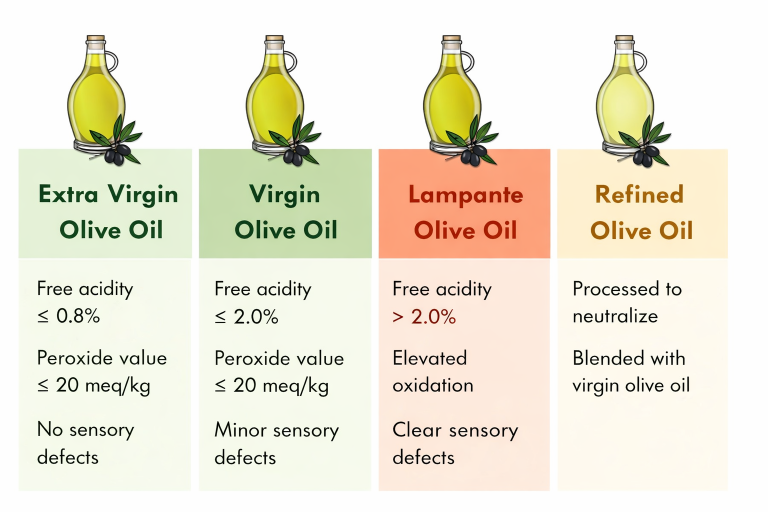
The Four Main Types of Olive Oil (Based on Chemistry)
Olive oil is officially classified into categories based on its chemical parameters and sensory characteristics. Each category reflects measurable differences in acidity, oxidation, and overall chemical integrity.
Extra virgin olive oil represents the highest grade, both chemically and sensorially. To qualify, its free acidity must not exceed 0.8%, a threshold that reflects excellent olive condition and immediate processing after harvest. At the same time, its peroxide value must remain at or below 20 milliequivalents of active oxygen per kilogram, indicating minimal oxidation. Additional parameters, such as ultraviolet absorbance (K232 ≤ 2.50 and K270 ≤ 0.22), confirm that the oil has not undergone degradation or adulteration. Beyond laboratory values, extra virgin olive oil must also pass sensory evaluation with zero defects and a positive median of fruitiness. In practice, high-quality examples often show even lower acidity and elevated polyphenol concentrations, contributing to both stability and nutritional value.
Virgin olive oil belongs to the same mechanical extraction category but allows for slightly lower standards. Its free acidity can reach up to 2.0%, and while its peroxide value remains within similar limits, minor sensory defects are permitted. Chemically, it may show early signs of oxidation or less optimal handling of the olives, which is reflected in a less refined sensory profile. Although still natural, it lacks the precision and balance that define extra virgin olive oil.
Lampante olive oil represents a significant drop in quality. Its free acidity exceeds 2.0%, often by a considerable margin, indicating poor fruit quality, fermentation, or delayed processing. Chemically, it may also exhibit elevated oxidation markers and problematic ultraviolet absorbance values, confirming degradation. Sensory analysis typically detects clear defects, such as unpleasant taste and smell. Due to this combination of chemical and sensory issues, lampante oil is not suitable for direct consumption and must be refined before entering the food chain.
Refined olive oil is produced by treating lower-quality oils, including lampante, through industrial processes designed to remove acidity, oxidation products, and sensory defects. As a result, its free acidity is reduced to very low levels, typically below 0.3%, and its chemical profile becomes stable and neutral. However, this process also removes most polyphenols and volatile compounds, significantly reducing both nutritional value and flavor complexity. The final product is often blended with a small percentage of virgin or extra virgin olive oil to restore some taste, but it remains fundamentally different from naturally produced oils.